
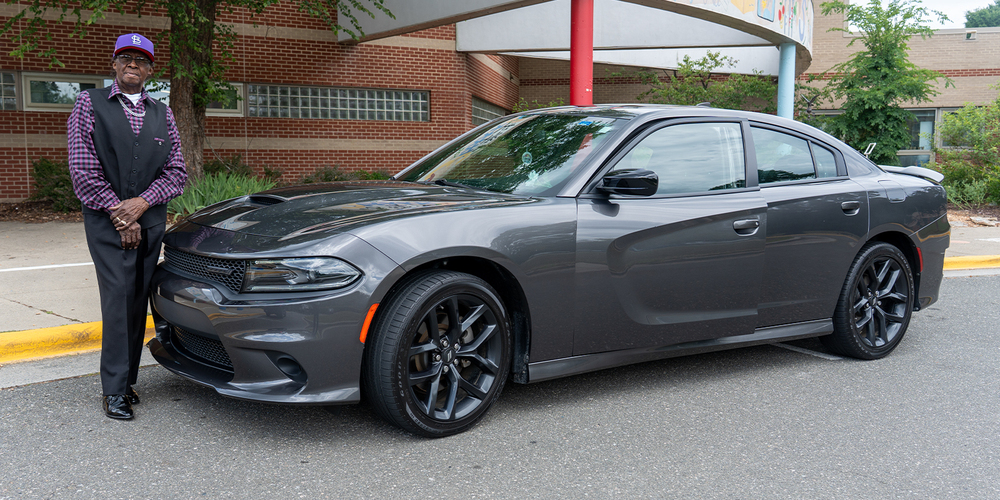
At 91 years old, John Mack continues serving students with faith, consistency, and pride.
Story written by Tony Cunningham, DPS Digital Communications Specialist
By the time I found John Mack inside the cafeteria at Forest View Elementary School, lunch was coming to a close.
The last few classes were moving through the lunch line. The room had started to quiet down. But near the back of the kitchen, Mr. Mack was still working.
At nearly 91 years old, he stood over a rack of baking sheets, drying them one by one with careful attention. He wore black hard-bottom shoes, dark slacks, a purple button-down shirt beneath a black vest, and a St. Louis Cardinals baseball cap pulled low over his head. Around his neck rested a silver chain that caught the cafeteria lights when he turned to greet me.
He smiled immediately.
“Hey, sir! I’m John Mack,” he said, extending his hand.
His grip was firm.
The cafeteria manager welcomed us into her office to talk. Mr. Mack leaned back comfortably in a rolling office chair while I settled onto a stool across from him. Then, slowly, the conversation began to unfold into something much bigger than a story about a man turning 91.
It became a story about faith.
About discipline.
About service.
About growing up Black in the rural South during segregation and carrying those lessons through nearly a century of American life.
And somehow, through all of it, still finding joy.
Mr. Mack began working at Forest View Elementary in 2003 after already retiring once before.
“I got tired of doing nothing,” he said.
So he applied for a position in school nutrition.
What he found instead was purpose.
“I love people,” he said. “I love children.”
Since arriving at Forest View, colleagues say Mr. Mack has never missed a day of work and has never once arrived late.
Not one day. Not once.
At nearly 91 years old, he still wakes up each morning and comes to serve children at the school.
That consistency, he says, did not begin at Forest View.
It started in South Carolina.
“I’m originally from South Carolina,” Mack told me. “Bennettsville.”
His voice softened as he began describing childhood.
He was raised in Cheraw, South Carolina, at a time when schools were small and widely spaced, and students often walked long distances just to attend class.
“It wasn’t section school,” he said. “It was like a house with all the rooms throughout. Each grade, one grade here and one grade there.”
But school, he remembered, was still something children looked forward to.
“You enjoyed it,” he said. “Most of us just loved to get there to get with your little friends.
Because when you got back home, it was nothing but work.”
Work, according to Mack, was not optional.
“Growing up, we had to work,” he said matter-of-factly. “I would go to school, get out at twelve, and come home and work until eight or nine o’clock at night.”
Sometimes that meant picking cotton.
A lot of cotton.
“I picked about four hundred pounds a day,” he said.
He laughed, remembering his brothers trying to avoid work while he worked harder than everyone else.
“They got in trouble because they didn’t work,” he said. “I got in trouble because I did too much work. I was up plowing fields at 2 and 3 o’clock in the morning when I was supposed to be in the bed.”
He laughed again while reflecting on those years.
The stories came steadily after that. They weren’t rushed. They weren’t dramatic. Just honest recollections from someone who has had enough years to look back clearly.
He often spoke about his parents and the structure they brought to the household.
“When they said yes, that was yes,” he said. “When they said no, that was no.”
There was no negotiation.
“No friends,” he said, smiling. “Your little friends were at school. When you got home, your parents weren’t your friends.”
That upbringing, he believes, shaped the man he became.
The work ethic. The punctuality. The discipline.
All of it traces back to those early years.
“My parents,” he said when I asked where his drive came from. “Because when they got up, you got up. They didn’t have to tell you something over and over.”
He paused for a moment.
“You grow into it.”
For Mr. Mack, punctuality is not about recognition. It is about responsibility.
“There’s two things I don’t like,” he said. “Missing work or being late.”
“Your word is your bond,” he told me. “If I tell you I’m going to do something, I’m going to do it.”
Even now, he says there have been mornings where he did not feel his best physically. But somehow, he still found his way to work.
“I just leave it in His hands,” he said, pointing upward. “Make that day’s work and go on back home.”
Faith sits at the center of nearly everything Mr. Mack talks about.
Before school cafeterias, before Durham, before retirement and second careers, there was church.
“One thing, I’m saved,” he said early in our conversation. “I try to live a life that I sing about.”
For more than 60 years, Mack has sung gospel music, especially quartet music, at church.
“It’s not so much the music,” he explained. “It’s the people.”
He smiled thinking about it.
“They enjoy service. Because they enjoy service, I enjoy.”
That spirit of service seems to follow him everywhere.
Inside Forest View Elementary, students search for him in the cafeteria line.
“A lot of them, if they don’t see me, they be calling for me,” he said.
That still makes him smile.
“The smile on their face,” he said softly. “That makes me feel good.”
What stood out most during our conversation was how deeply he believes children deserve dignity.
“I’ve noticed some people treat the little students like they’re small,” he said. “I realize they’re small, but they’re human.”
Then he leaned forward slightly.
“He loves them just as much as He loves me.”
Over the years, some former students have returned to visit him as adults. A few even came back to Forest View as teachers.
“One or two came back here as a teacher,” he said proudly.
Moments like that matter to him.
“It makes me feel good,” he said. “I just want to keep on.”
As we talked, Mr. Mack reflected on the enormous amount of history he has witnessed since being born in the 1930s.
The Civil Rights Movement.
Segregation.
Martin Luther King Jr.
The election of Barack Obama.
Massive changes in technology, education, culture, and community life.
But he rarely spoke about history through the lens of politics. He spoke about it through people.
“Try to do the right thing,” he said. “Sometimes you don’t know if it’s right or wrong, but you do what you think is right.”
Mr. Mack eventually moved to Durham in the 1950s after getting married. His wife had family in the city.
“It was just like a circle,” he said while describing how life eventually brought him back to Durham after years spent elsewhere, including time in Greensboro and periods traveling to sing gospel music.
But Durham became home.
And Forest View became part of that home, too.
At one point during the conversation, he spoke about the atmosphere among the school’s staff and why he has stayed so long.
“It makes you want to come in in the morning,” he said. “To meet that smile on their face and know they’re going to take care of the little students.”
Even after 23 years, he still talks about work with gratitude instead of exhaustion.
That perspective feels increasingly rare.
Especially at 91 years old.
After we finished talking, Mr. Mack pulled his car around to the front of the school so I could see it.
Outside in the parking lot sat his Dodge Charger GT.
The exterior looked freshly polished. The tires gleamed. When he started the engine, a deep growl rolled through the parking lot, and suddenly the reserved cafeteria worker became animated with excitement.
He opened the driver’s door, and all you saw was the reflection of the sun from his gold teeth.
The smile on his face looked youthful.
Proud.
Alive.
It was impossible not to notice the contrast between the calm, reflective man in the office and the excitement that came over him as he stood beside his prized possession.
But maybe, just maybe, it was not really a contrast at all.
The same care he put into his appearance, his work ethic, his faith, and his consistency was evident in the way he maintained his Charger parked outside.
Everything about Mr. Mack reflects intention.
Before I left campus, he walked me over to speak with another employee, Mr. Hill, who immediately lit up when talking about him. The two posed for a picture together, smiling like old friends.
Then Mack shook my hand one more time.
“Maybe I’ll see you at a program sometime,” he said. “I gotta see you thump that bass.”
At 91 years old, Mr. John Mack could be at home resting comfortably in retirement.
Instead, each morning, he still wakes up and comes to serve children at Forest View Elementary School.
Still smiling.
Still “sangin’.”
Still showing up.