
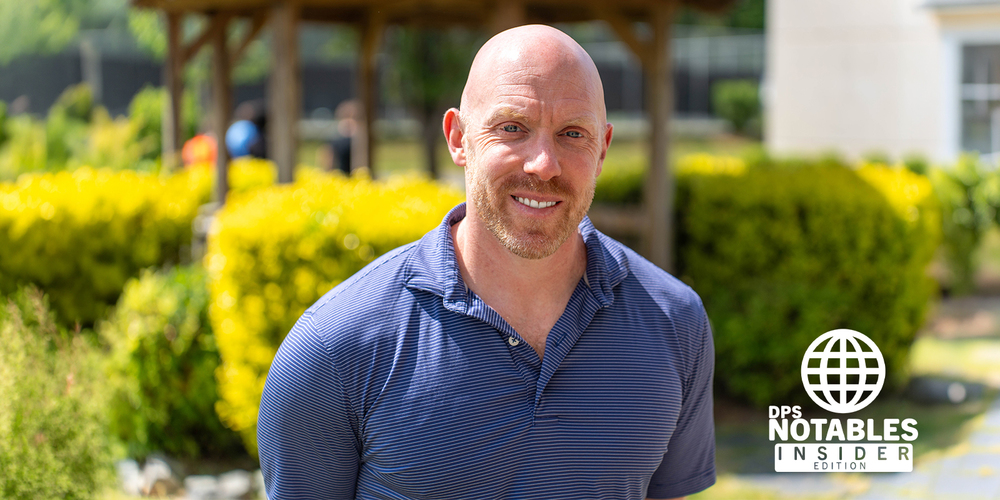
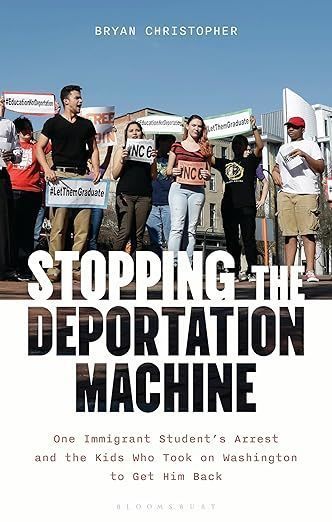
Riverside High School’s Bryan Christopher was en route to participate in a community conversation about immigration on the campus of Wake Forest University where he earned his Master’s degree when he took the time to share the story behind a story. He’s recently authored his first book, Stopping the Deportation Machine, about 2017 Riverside High School graduate Wildin Acosta, who was arrested and detained while on his way to school early one morning in 2016.
Christopher, who teaches English and serves as the advisor of the Pirate’s Hook school newspaper, had been teaching for 10 years at the time. Although he was aware of the far-reaching impacts of immigration, he had no idea how close it would hit home. What he also didn’t know was that Wildin and his family were living in Durham to avoid gang violence in Honduras in 2014.
Christopher and his students then began a journey of advocacy and speaking truth to power that captured local, state, and national attention, and ‘The rest, as they say, is history.’
With one of their own peers having been arrested, detained, and set to be deported, Christopher’s journalism students discussed non-negotiable coverage. 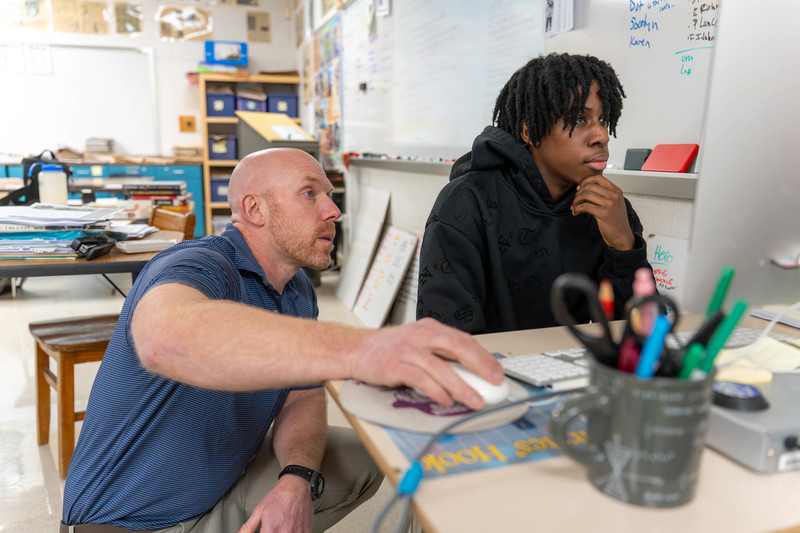
“It was a very impactful event for our student body,” he said. “They covered community events, vigils, organizations, school board meetings, student council meetings and watched news coverage. The Pirate’s Hook (Riverside’s student newspaper) covered it, and bilingual newspaper staff members had unique access to family members,” he said. “They did some really outstanding work and gained unique expertise on the topics.”
Christopher said the newspaper staff split into teams: half covered the event; the other half served as advocates.
By March 2016, his students had engaged lawmakers while Wildin remained indefinitely in a Georgia detention facility. Meanwhile, the students placed continual pressure on elected officials to get him released so he could finish his high school courses and earn his diploma. Their voices were heard, and U.S. Congressman G. K. Butterfield visited Riverside that year in April.
Then, four Pirate’s Hook journalism students went to Washington to brief Congress on the devastating impact of immigration rates on attendance.
Christopher, who himself writes for teacher publications, said, “Their own advocacy really started to take off. I realized that this does not happen every day, and what was happening was remarkable.”
As Wildin remained detained throughout Spring graduation and into the Summer, the students and Christopher’s fellow teachers continued chipping away at the issue. Finally, the Board of Immigration Appeals agreed to re-open Wildin’s case for asylum in July. Then, a breakthrough: in early August, a judge ordered his release from detention, and he returned home in August. Wildin returned to Riverside in Fall 2016 and walked across the stage in the 2017 ceremony.
How did that feel to Christopher? He admits to a myriad of emotions.
“In the moment, I was just trying to keep up with the kids. This was a very impactful story that we were covering. We knew we had to get the facts right. I have not personally had to navigate the immigration system. There was a lot I didn't know about what was happening to Wildin and why. I was working hard to read up on everything and to make sure I could help students edit their stories.”
Once the stories were edited, they needed to be read by an audience.
“As they started to publish and their advocacy was working, I was trying to help amplify their messages and just support them in ways that I could,” Christopher said.
He’s quick to note that he doesn’t claim to be Atlas. His colleagues' shoulders are pretty strong too.
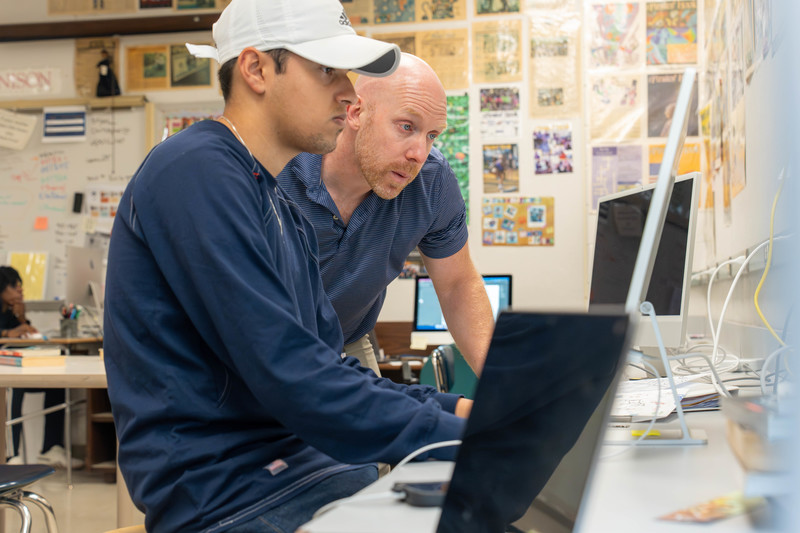
“They had the help of a lot of other teachers too. I was not on the front lines of the advocacy efforts…I just had to do a lot of homework and educating myself on how these immigration policies were affecting education so that I could make sure the students could do their work…on their academic assignments for the newspaper. It always felt like there was a close connection to our academic work,” he said.
Christopher said the experience was extraordinary.
“When he (Wildin) finally did return, I was amazed by the way the students had to grow up so fast and learn so much to advocate for their classmate and for all students,” he said.
The Graduate
Naturally life moves on.
Nearly a decade has passed since Wildin’s graduation; he and his fellow advocates have moved on to college and careers, and immigration continues to dominate the headlines. Christopher said when the familiarity of Wildin’s story began to dissipate, he wanted to bring it back to the forefront.
“Local media had covered his story, but I wanted people to know what happened. I reached out to Wildin to determine if he was interested in telling his whole story,” said Christopher.
Wildin told his teacher his whole story– before, during and after the events of 2016. The outcome, Stopping the Deportation Machine, tells of Wildin’s lived experiences while he was detained as well as his teacher’s observances in Durham, and the advocacy that restored his right to graduate, giving the reader both perspectives. The story, Christopher, said, took several years to write. He completed the manuscript in 2024, found a publisher in 2025, and the book became available in September 2025. The two have toured together to share their story, hold conversation, and answer questions.
“Appearing together has been really powerful because people can hear Wildin’s voice,” said Christopher. In addition to amplifying Wildin’s voice, Christopher hopes to spread several messages:
“We hope the book, regardless of politics, will foster more informed conversations about difficult topics like immigration.”
“The story is also a powerful example of the ripple effects of an arrest.”
“The power of young voices.”
Christopher is proud of his journalism and English students for the way in which they used their writing skills and speech to advocate for their contemporary.
“As a teacher, I've always wanted kids to become writers and strong communicators but also feel like they have the skills to write and communicate something that matters, and you can’t do that without empowering kids to make their own choices sometimes so journalism gives them a chance to be curious about topics, to ask a lot of questions, and also to see the consequences of their writing sometimes.”
Christopher explains what he means by his use of the word consequence: “It’s a unique opportunity for them to write to an audience other than just their teacher because we want their work to be read, and we do publish it to an audience of their school community sometimes beyond. We want reader feedback and we want to know the impact that it has. That's an important piece of what we do because it informs our coverage and it’s a powerful learning opportunity for them. The scope and scale of the stories evolve but the work itself is pretty consistent.”
He’s quick to mention the consistency and commitment of his colleagues as well.
“There’s some really great teachers in Durham that work really hard for all of their students. Many of them are key characters in the book. The students were certainly remarkable but they had a lot of really great teachers who were leading from behind and supporting them in ways that I think teachers in our district do for all students even if it’s not in the headlines every day,” he said.
Since Stopping the Deportation Machine has been published, Christopher and Wildin have appeared in Durham and Chapel Hill bookstores; on Due South radio show with Leoneda Inge; and have been featured in The Indy publication. Christopher has presented on the topic at conferences including the National Council of Teachers of English (The Power of Embracing Bilingual Student Expression)
Columbia Scholastic Journalism Association Spring Conference: How Student Journalists Can Push Into Professional Media Landscapes, and a community conversation at Wake Forest University at the Z. Smith Reynolds Library community conversation
The book can be found at local bookstores and all major retailers.
*Note: Christopher’s journalism students have won the NC Scholastic Media Association Tar Heel Award for the past two years at the North Carolina Scholastic Association. Additionally, Pirates' Hook alumni represent Riverside in media professions all over the country, including The Indy publication based here in Durham, in television news outlets, as well as for professional sports franchises.