
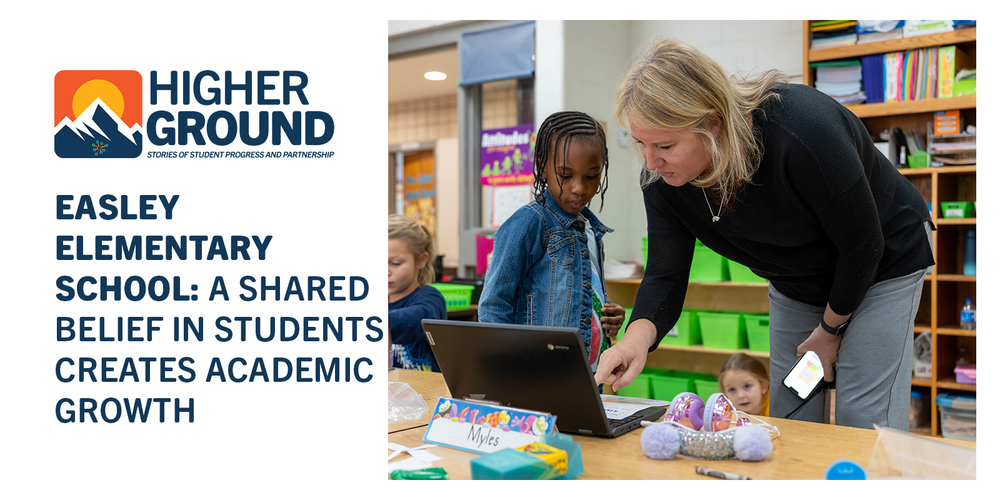
At Easley Elementary, daily practices and a culture rooted in relationships, intentional teaching, and a shared belief that every student can grow from wherever they begin their tenure at the school drive its steady and upward progressive academic growth.
That mindset is showing up in the data.
While Easley met overall growth this year, the school exceeded growth in reading once again—continuing a multi-year pattern that reflects deliberate, long-term work rather than quick fixes. But leaders and teachers are quick to point out that the real story of intentionality and meaningful relationships lives beyond the numbers.
“We start by meeting kids exactly where they are when they first walk through the door those first ten days,” said Mary Woznicki, a third grade teacher whose students not only met but exceeded growth.
Part of her job, she says, is to introduce the concept of growth to students. “Growth only matters if students understand what it means for them. Setting high expectations from the very beginning, routines and procedures on just about everything…because if those types of foundation things are strong just in general, like classroom expectations, then when you get to the academic expectations, that's going to be a little bit easier…that’s the starting point.”
That belief is echoed across grade levels—from first through fourth—by teachers who exceeded growth with their students this year.
In first grade, where learning to read is pivotal, high expectations and encouragement are woven into daily routines. Teachers emphasize positive mantras, risk-taking, and consistency, helping even the youngest learners see themselves as capable readers. In doing so, students learn and begin to understand what their own growth looks like, said Dr. Hauser.
“In first grade, confidence matters just as much as phonics,” said first grade teacher Sandra Ebbert. “When students believe they can do hard things, they rise to the challenge.”
By third grade, when standardized testing is introduced, teachers focus on demystifying growth. Students learn that progress isn’t about comparison—it’s about becoming a stronger reader, writer, or mathematician than they were at the start of the year. Teachers hold regular data conversations with students, celebrating gains and helping them set clear, actionable goals.
Fourth-grade teacher Abby Exum described how growth is made visible: “We don’t focus on labels. We focus on progress—how far you’ve come and what your next step is.” She celebrates growth with her students and communicates it with parents. Exum said she has a sign in her room that touts, ‘Practice makes progress.’
Easley’s staff meets regularly in professional learning communities (PLCs) to analyze data, reflect on instruction, and plan next steps together. This student-centered approach is reinforced by strong systems behind the scenes, according to the school’s Instructional Coach Robert Jones.
“We do a great job of looking at data here and actually doing something with it so we’ll have data PLCs and reflect and come back with next steps. In professional development, we’ll look at that data and what we’ll need to give teachers to meet the kids where they’re at and focus on that growth piece. We do a really good job of using our data,” he said.
But again, numbers are only part of the story.
“If a kid doesn’t feel connected, it doesn’t matter how great of a teacher you are, they're not going to learn if they’re not feeling safe and cared about,” said Dr. Hauser.
Said Jones, “Our teachers are so knowledgeable about their students. In PLCs, you can ask them questions (about their students) or social-emotionally or family life and they know because they care about their kids. I have a lot of respect for that because you have 20-plus kids in that room and you know them so well because you care.”
With that in mind, Dr. Hauser believes she is also obligated to keep teaching at the forefront.
“One of my main roles is protecting teachers’ time so they can focus on teaching,” Hauser said. “When systems and structures are clear, instruction doesn’t get disrupted.”
That consistent advocacy has helped Easley maintain low teacher turnover—allowing educators to grow alongside their students and deeply understand the community they serve. Teachers know not only their own students, but often entire grade levels, thanks to flexible grouping and collaboration.
Dr. Hauser says her focus is to create a growth mindset culture at Easley by tracking data and monitoring growth with teachers and with students. There is shared ownership over student data, shared flexible grouping across grade levels, an “our kids” mentality, and celebrating the growth made as teams and as a school.
Accordingly, relationships are at the heart of Easley’s success—not just with students, but with families as well. Clear expectations for parent communication are established early, with frequent newsletters, multiple platforms for connection, and proactive outreach that begins with positive contact in the first weeks of school.
Parents receive weekly newsletters, a joint grade level newsletter every other week, the website is kept up to date, regular emails are shared, and the PTA is active. The school has a Facebook page as well.
“We believe in over-communicating,” Hauser said. “Families are partners in this work.” Teachers are asked to reach out to parents at least three times, when trying to schedule conferences. Administration will then conduct outreach if a teacher is not able.
Parent communication is vital, said Woznicki.
That partnership has extended beyond academics. In recent years, Easley’s community has rallied together during times of uncertainty—organizing food pantries, supporting families affected by policy changes, and hosting inclusive, free community events. The result is a school culture that supports the whole child—and the whole family.
As Easley’s population continues to shift, including a growing number of English language learners, the school is adapting thoughtfully. Leaders anticipate temporary dips in proficiency as part of the district’s “Growing Together” initiative, but they remain confident in the trajectory.
“There’s a story behind the numbers,” Hauser said. “When you know your students, set high expectations, and meet them where they are, the growth will come—and it will be meaningful.”
At Easley Elementary, growth isn’t about chasing a statistic. It’s about sustained progress, shared ownership, a supportive system and structure, and a community that believes—year after year—that higher ground is attainable and sustainable together.